Gallery
Showing posts with label Alfa Romeo concepts. Show all posts

Wednesday, August 31, 2011

Alfa 4C Concept Updated


Alfa Romeo 4C Concept is "Ambassador DNA Technology"

Unveiled in a world premier at the Geneva Motor Show last April and voted "Most Beautiful Concept Car of the Year" by the readers of the German magazine, Auto Bild, the Alfa Romeo 4C Concept exhibited in Frankfurt is distinguished by a new and exclusive "Fluid Metal" exterior colour. This new livery, like a sheet of forged metal, perfectly fits on the 4C Concept shapes with a fluid and liquid pigment that combined with the base creates a silvery reflecting effect and by dynamically running down the sinuous line of the car enhances its force and technicality.
Planned to go on sale during 2013, when it is set to reinforce Alfa Romeo's global growth plan, starting today this compact "supercar" is "Ambassador DNA Technology", or ambassador of the engineering heritage that distinguishes the Alfa Romeo vehicles of today and tomorrow, representing their most advanced level.
In fact, the performance and dynamics of the 4C Concept car are enhanced by transferring the perfect equilibrium between pleasure and thrill of performance with the awareness of efficiency and active and passive safety to the daily driving experience.
The concept presents the formula of the two-seater, rear-wheel drive coupé with its central engine, a length of approximately 4 metres and a wheelbase of less than 2.4 metres. These dimensions on the one hand emphasise the car's compact attributes while also accentuating its agility on the other. Distinguished by its clean and graceful lines, the same principles are also applied to the inside, with the Concept's specific trim level, maintaining features and devices which more directly reflect the car's sporting spirit.
The Alfa Romeo 4C Concept uses technology and materials derived from the 8C Competizione - carbon, aluminium, rear-wheel drive - and technology from Alfa Romeo models currently on sale: the 1750 turbo petrol engine with direct injection, the "Alfa TCT" twin dry clutch transmission and the Alfa D.N.A. selector for dynamic control of the car, in short all the best of the Alfa Romeo DNA Technology.
This vehicle quite simply screams Alfa. Its sports car soul creates a unique driving sensation, both on the road and when racing, where its velocity and transverse acceleration become even more demanding.
Born from the experience acquired through the Alfa Romeo 8C Competizione and 8C Spider models, the new concept car shares its rear-wheel drive with the exclusive supercars as well as its philosophy based on achieving maximum driving pleasure and the proverbial Alfa Romeo road handling. This is an objective which the 8C Competizione and the 8C Spider pursue mainly through their increased power, while the Alfa Romeo 4C Concept follows the route of limited weight, made possible by extensive use of carbon, which also plays a structural role and guarantees exceptional agility with a weight/power ratio which is lower than 4 kg/HP. The chassis supports a body crafted completely from carbon, inside which there is space for the driver and passenger, while the rear frame structure and the crash boxes use aluminium extensively. The final result is a significant reduction in weight, limited to roughly 850 kg, as well as the optimisation of the vehicle's centre of gravity, which gives the advantage of increased agility and drivability on the most challenging roads.
The name "4C Concept" is suggestive of the sports driving pleasure which only the spectacular "4 cylinder" 1750 Turbo Petrol engine which offers over 200 HP can bring. Already featured on a number of models in production, for example the Giulietta Quadrifoglio Verde, the engine boasts cutting-edge technical solutions such as direct fuel injection, dual continuous variable valve timing, a turbocharger and a revolutionary scavenging control system which eliminates any turbo lag.
Located centrally in the rear of the vehicle, the engine in the Alfa Romeo 4C Concept ensures performance which matches or exceeds that of a 3 litre engine whilst still delivering the moderate fuel consumption which is typical of a compact, 4 cylinder engine. Coupled with the new automatic "Alfa TCT" twin dry clutch transmission, now available on the MiTo and Giulietta, the powerful 1750 Turbo petrol engine allows the 4C Concept to reach a top speed of over 250 km/h and to accelerate from 0 to 100 km/h in under 5 seconds.
This car was built to represent the most advanced level of "D.N.A. Technology". It perfectly combines all the Alfa Romeo technologies available on-board, making them enjoyable and customisable for the driver also by the Alfa D.N.A. dynamic vehicle control selector that is its physical expression inside the interior. All of this accentuates to an even greater extent the competitive nature of the Concept compared to other cars currently on sale.
The Alfa Romeo 4C Concept has an extremely sophisticated suspension layout (high quadrilateral at the front, MacPherson at the rear) to ensure maximum agility and road holding. This solution, along with the rear-wheel drive and the extraordinary weight to power ratio, ensures Alfa Romeo driving pleasure, enhanced even further by the weight distribution (40% on the front axle and 60% on the rear axle). The Concept takes up the brand's sporting tradition, taking us back to its origins when agility and the weight to power ratio were the keys to a successful racing vehicle, and combining these aspects with the Alfa Romeos which take to the road every day.


Monday, July 4, 2011

ImageGallery: Alfa Romeo Bertone BAT

BAT 9 '1955

BAT 7 '1954

BAT 5 '1953


Tuesday, March 1, 2011

First Pics: Alfa Romeo 4C Concept


Alfa Romeo 4C Concept

Alfa Romeo 4C Concept made its debut at the 81st Geneva International Motor Show. This compact "supercar" which represents the true essence of a sports car, according to the brand's values: performance, Italian style and technical excellence aimed at maximum driving pleasure in total safety.
The new concept presents the classic formula of the two-seater, rear-wheel drive coupé with its engine at the centre, a length of approximately 4 metres and a wheelbase of less than 2.4 metres: dimensions which serve both to emphasise the compact size of the car and to accentuate its agility. Distinguished by its graceful and clean external lines, the same principles are also applied to the inside, with the Concept's specific on-board design maintaining features and devices which directly reflect the car's sporting spirit.
On the Alfa Romeo 4C Concept technology and materials derived from the 8C Competizione find a home - carbon, aluminium, rear-wheel drive - and technology derived from Alfa Romeo models currently on sale: the 1750 turbo petrol engine with direct injection, the "Alfa TCT" twin dry clutch transmission and the Alfa DNA dynamic control selector.
Quite simply, this vehicle screams Alfa. Its sports car soul creates a unique driving sensation, both on the road and when racing, where its velocity and transverse acceleration become even more demanding.

Born from the experience acquired through the Alfa Romeo 8C Competizione and 8C Spider models, the new concept car shares its rear-wheel drive with the exclusive supercars as well as its philosophy based on achieving maximum driving pleasure and the proverbial Alfa Romeo road handling. This is an objective which the 8C Competizione and the 8C Spider pursue mainly through their increased power, while the Alfa Romeo 4C Concept follows the route of limited weight, made possible by extensive use of carbon, which also plays a structural role and guarantees exceptional agility with a weight/power ratio which is lower than 4 kg/HP. The chassis supports a body crafted completely from carbon, inside which there is space for the driver and passenger, while the rear frame structure and the crash boxes use aluminium extensively. The final result is a significant reduction in weight, limited to less than 850 kg, as well as the optimisation of the vehicle's centre of gravity, which gives the advantage of increased agility and drivability on the most challenging roads.


The name "4C Concept" is suggestive of the sports driving pleasure which only the spectacular "4 cylinder" 1750 Turbo Petrol engine which offers over 200 HP can bring. Already featured on a number of models in production, for example the Giulietta Quadrifoglio Verde, the engine boasts cutting-edge technical solutions such as direct injection, dual continuous variable valve timing, turbocharger and the revolutionary scavenging control system which eliminates turbo lag.
Located centrally in the rear of the vehicle, the engine in the Alfa Romeo 4C Concept ensures performance which matches or exceeds that of a 3 litre engine whilst still delivering the moderate fuel consumption which is typical of a compact, 4 cylinder engine. Coupled with the new automatic "Alfa TCT" twin dry clutch transmission, launched only a few months ago on the MiTo and which will soon be available on the Giulietta, the powerful 1750 Turbo petrol engine allows the Alfa Romeo 4C Concept to reach a top speed of over 250 km/h and to accelerate from 0 to 100km in under 5 seconds. The vehicle integrates its Alfa DNA technology perfectly, a true philosophy which brings together all of the on-board technology, making it enjoyable and customisable for the driver and further accentuating the "competitive" nature of the Concept compared to other vehicles currently on sale.


The Alfa Romeo 4C Concept has an extremely sophisticated suspension layout (high quadrilateral at the front, MacPherson at the rear) to ensure maximum agility and road handling. This solution, along with the rear-wheel drive and the extraordinary weight/power ratio, ensures Alfa Romeo driving pleasure, enhanced even further by the weight distribution (40% on the front axle and 60% on the rear axle). The Concept takes up the Brand's sporting tradition, taking us back to its origins, when agility and the weight/power ratio were the keys to a successful racing vehicle, and combining these aspects with the Alfa Romeos which take to the road every day.
This car is not simply an exercise in style created for the Motor Show; it will be on sale in 2012 and is set to reinforce Alfa Romeo's global growth.

Saturday, January 8, 2011

Alfa Romeo Navajo

The final 33 Stradale-based dream car was Bertone’s Navajo that debuted in March 1976 at the Geneva Salon.


The Navajo symbolised the new accord between the Turin bodywork designer and Alfa Romeo, a partnership which over the years had turned out many world famous cars. Names like the Giulietta Sprint, Canguro, Giulia GT, Carabo and Montreal evoke fundamental steps in the evolution of the sports car.

Despite its intentional design excesses, the Navajo represents a concrete idea for a sporty coupé based on the prestigious mechanics of the Alfa 33. The original tubular chassis was lengthened and adapted to create optimum room for two passengers. The bodywork, entirely in fibreglass, together with the chassis, gives an excellent result in terms of weight. Given the availability of generously powerful engines, the Bertone designers focussed their attention on the aerodynamic questions related to road holding, as well as thinking of pure speed. The Navajo benefits from this approach both in general design terms, and as far as accessories are concerned. The frontal view is extremely tapered, reducing air resistance to a minimum, and to this end, the car also features a brand new and very original front spoiler, which automatically regulates the angle with the ground according to the speed of the vehicle.
 
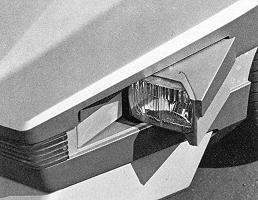
The rear wings, aside from providing an interesting aesthetic motif, represent a valid support for the generous rear spoiler, which is also adjustable. The disappearing headlamps open horizontally to the plane of the car.

Presented at the Geneva Motor Show in March 1976, the Navajo captured the attention of public and experts alike: the avant-garde solutions on show were yet another demonstration of the designer’s unique style, constantly experimenting and ahead of its time.

Source: carstyling.ru; www.qv500.com; www.bertone.it

Monday, December 20, 2010

Bertone Alfa Romeo Pandion Concept

Named for a fierce sea hawk, the Pandion has spectacular 12-foot-long doors, inspired by the flying predator’s wings.


"The skin refers to the snake, for Italy’s seductive auto beauty, the cross for the country’s excellence in tech advancements"


Press Release:

PANDION
A DREAM ALFA ROMEO BY BERTONE

The Pandion: a summary
After a two year absence from the international scene, Bertone returns to the Geneva Motor Show, unveiling a concept car that makes its world premiere here: the Pandion, an aggressive yet beautiful coupé designed as a tribute to Alfa Romeos’ one hundred year anniversary.
The Pandion: an extreme and controversial sports car in typical Bertone fashion. The size of the concept car (4620 mm in length, 1971 mm wide, 1230 mm high, 2850 mm wheelbase) offers a compact sports car external dimensions with a large sports car interior feeling, all powered by a 4.7 litre, 450 CV 8-cylinder Alfa Romeo engine.
The Pandion is the first car produced by Mike Robinson in his new role as Design and Brand Director at Bertone. A pure “˜dream car’, the Pandion takes its rightful place as a member of Bertone’s historic Alfa Romeo family: cars that have always been style icons, influencing the history of the automobile and Italian craftsmanship in their excellent design quality, proving themselves to be undisputed benchmarks for the entire world of car design.
The name comes from the animal world, as Pandion Haliaetus is the scientific name for an Osprey: a sea hawk that nests and lives in coastal areas. The designers, led by Mike Robinson, have drawn inspiration from the wings of this predator to invent the spectacular door opening mechanisms, and from the hawks’ facial markings to project the traditional Alfa family feeling into the next era of design.
In almost a century of Bertone tradition, it is not the first time that natural wonders have inspired the names of concept cars. Just think of the Corvair Testudo (1963) and, by no coincidence, the Alfa Romeo Canguro (1964), Carabo (1968) and Delfino (1983).
Design: the initial concept
The Pandion’s taut and muscular body is the result of an original interpretation of the Alfa Romeo badge, where the man-eating snake depicted there represents the attraction of elegance (what we call the “˜Skin’), and the aristocratic cross symbolises the rigour of rational thought, the technological aspect (what we call the “˜Frame’). According to this interpretation, the Pandion’s design is, like every Alfa Romeo, a perfect synthesis between “˜Skin and Frame’, an ideal balance resulting from a tension between opposites: technology and sensuality, rationality and instinct, architecture and sculpture, structuralism and organicism, industrial excellence and excellent craftsmanship.
The design of the Pandion is based on a concept Robinson calls: “Skin & Frame” – a new interpretation of the inherent duality in the 100 year old Alfa Romeo logo. “Skin” refers to the snake in the logo, representing the world renowned Italian excellence in beautiful, seductive forms; and “Frame” refers to the cross in the logo, representing the mechanical excellence in high performance Italian race cars. The combination of the two has now become a dynamic dial searching for an ideal balance resulting from the tension between opposites: technology and sensuality, rational and emotional, architectural layout and sculptural form, structural and organic, industrial excellence and artisan excellence.
According to this interpretation, the vibrant energy in every Alfa Romeo is represented by Pandions’ spinal structure (or “˜Frame’), which crosses the length of the car from the V-shaped grille in the nose of the car to the V-shaped bumper in the tail of the car, crossing the interior as a visually aesthetic structural element which supports the surrounding shell (or “˜Skin’).

Design: details that count
The Pandion’s front end features a long and sculpted sloping bonnet that creates what is, to all intents and purposes, a mask, almost like the helmets worn by ancient warriors. The Alfa Romeo “˜family feeling’, immediately recognizable at first glance, does not admit even a hint of retro nostalgia and looks to the future with a revolutionary and novel elegance. There is no doubt it’s an Alfa Romeo with a look that has never been seen heretofore. The typical Alfa quad headlights are buried deep in the outer-most tips of the T-shaped grille, highlighting the wide stance of the impressive coupé. Four white bars of light strike the observers’ curiosity, two position lights above and two fog lights below, creating a virtual bi-plane of light at night. The typical five horizontal bars on every Alfa Romeo radiator grille are just visible here, offering a reference to the marque’s historic identity. The front grille is full of thousands of tiny intertwined blades which contribute to the new Algorithmic Design throughout the car.

The Pandion has the profile of a true sports car, with no room for compromise. The architectural layout is “˜cab rearward’, meaning the passenger compartment is positioned towards the rear of the car and the long bonnet pushes the car’s visual centre rearward. The body side visually connects the sensuous front end with the razor-edged rear by means of an extremely long flowing side window which stretches from front wheel arch to rear, enhancing the excellent accessibility of this low-bodied sports coupé. Since sports cars are traditionally difficult to get in and out of, this important ergonomic activity has been facilitated with an extra wide door opening to make up for the low roofline. This new graphic formula not only adds a striking new visual division between the upper and lower parts of the body, but it also offers an incredible panorama window for passengers inside. The strong diagonal dark-light division in the rear of the side view accentuates the powerful rear wheel drive layout and draws special attention to the hidden door opening mechanism.
The rear end features a striking array of crystal-like blades which are intertwined in various widths and lengths, protruding out into space. The rear of the car in fact has a disembodied or “pixilated” look, representing a tail-of-the-comet metaphor, as if the sheer speed of the vehicle is pulling the underlying, technical “Frame” rearward, away from the sensuous, flowing “Skin” above. This “dematerialization” phenomenon of the car is generated by the intrinsic motion of the form, which means the car looks like it is moving even when it is standing still.
There are also two small fixed white shields below the rear bumper which hold the quad tailpipes, creating a visual continuation of the white side panels which seem to wrap around under the car.


The taillights are fully integrated into the organic tangle of the blades and disappear when turned off. The new Alfa Romeo family feeling is again visible in the rear of the car with same V-shaped bumper found on the front of the vehicle, which the travels the entire length of the body, forming a powerful virtual, Alfa Romeo backbone.
The doors, as in many other Bertone-designed masterpieces (such as the 1968 Alfa Romeo Carabo, the 1970 Lancia Stratos 0, the 1972 Lamborghini Countach, and the 2007 Fiat Barchetta), open in a visually striking manner. Virtually hinged around the axis of the rear wheel, the Pandion doors open by rotating backwards, ending up a perfect 90 degrees above the center of the rear wheel, lifting up the entire body side of the vehicle, from the front fender to the rear fender. When fully open they are more than 3.6 metres high. This spectacular solution is design mainly for glamour, bringing back the “wow” factor to today’s lackluster automotive industry. This futuristic door mechanism also has a pragmatic side as well. Since all “˜extreme’ sports cars are literally impossible to get in and out of, the Pandion is designed to utilize the horizontal space in the car since the vertical space is so limited.
In the event of an accident that results in a “˜roll-over’, the doors detach from the car body so that the passengers can exit of the car.

The interior: minimalist glamour
The shapes that make the Pandion spring to life are the result of a design study aimed at creating an organic whole, without resorting to short-cuts to ensure continuity between the interior and exterior, a perfect balance between architectural rigour and the spectacular shapes of living organisms.

The design language used to create the passenger compartment has resulted in a fluid environment, due to the fittings that seem to have grown spontaneously, without ever having been either designed or constructed. We have named this expressive code, never seen before in the automotive sector until today, algorithmic design. The concept, taken from the world of mathematics, indicates an organic alternative to traditional design and is the “˜propagation of random forms’. It is as if the design were following a kind of complex development which is neither linear nor geometric, generating an “˜auto-organising’ shape, with the “˜spontaneous growth’ of algorithms such as “˜swarms’ or “˜vines’.

When observing the interior of the Pandion, the first things that draw our attention are the front seats. The car’s layout is typical of Alfa Romeo coupés, i.e. 2+2. While the two rear seats are the classic “˜extra spaces’, the front seats are two incredibly thin (30 mm) ergonomic chaise longue chairs. They have carbon fiber shells (that mimic the style of the car’s exoskeleton or “˜skin’) covered in Technogel® and backlit with reLIGHT® fabric, that conforms to the shape of the driver’s or passenger’s body. The principle that inspired the designers was that of “˜zero gravity’, i.e. a warm and welcoming environment that would convey a sensation of enhanced quality of life inside at first sight, but… with zero gravity.
In fact, all the furnishings inside the passenger compartment all tend to float visually, suspended in the magic of the blue light. Behind these minimalist choices however lies a careful study of ergonomics: the seats are the result of a perfect synthesis between high performance, flexibility and lightness. The clear floor is illuminated in the same “swimming pool blue” color of the seats, offering a spectacular visual continuation of the voluptuous seats, with its’ flowing contours where the driver and passenger can feel protected in a truly glamorous shell.
The steering wheel is clearly that of a sports car, while the controls are similar to those of Alfa Romeo race cars, with two analogue dials placed directly on the steering column. Three of the four LCD screens offer a rear view inside the passenger compartment (two on the sides, one on the windscreen) and they are directly connected to the external video cameras that substitute the rear view mirrors normally placed outside the car. The larger screen placed in the centre (9″), in the middle of the console – and within reach of the passenger as well as the driver – also displays information on the car’s systems (air conditioning, sound systems, Sat Nav, etc…).

Conclusion

“We are walking in the footprints of giants" 

That is the Bertone company motto. The giants referred to are Giovanni and Nuccio Bertone. However, following in their footsteps does not mean copying them, on the contrary. It means applying their teachings and using them as guidelines for further advances. We ask our designers to follow a total creative method, where they observe phenomena that are apparently unrelated to each other and try to apply them to the automotive world.
However design research is not enough. At Bertone we study concepts, and therefore each design is the result or a spinoff of an innovative idea or a new phenomenon. Mike Robinson, Design & Brand Director at Bertone, comments: “˜Cars are like films: they must tell a story to win people over. The best car designers are necessarily excellent narrators and their products, whether they are concept cars or mass-produced products, reflect their creators’ ability to gather fascinating ideas from every field, from all over the world, to bring them together and transform them into new and great stories. This is what we have attempted to do with the Alfa Pandion.’